Monday, April 21, 2014

Solutions and Solubility

Solutions and Solubility

1. Solutions
2.  Molarity
3. Molality formula
4. Dilutions formula
5. Solubility

Solutions

What is a solution?
A solution is a homogeneous mixture in which one substance is dissolved in another substance.
For example:


 In this example the substance being dissolved is salt and it is being dissolved in water.


There are three factors that affect the rate of solutions (how fast they dissolve) and affect solubility:
1. Stirring 
2. Particle size (the smaller the better, it covers more surface area)
3. Thermal energy (heat) 

Temperature (thermal energy) is different for gases. Unlike liquid and solids, gases become less soluble as the temperature increases.

Molarity

Molarity represents the number of moles of solute per liter of solution.
          moles
M =  -------
          liters

i. How many grams of CaCl2 are in 350 mL of 2.0 M CaCl2 solution?
First you have to figure out what the moles are by using the formula for molarity (above).
So the equation would be moles= Molarity x Liters
plug in the numbers and solve:
                          m = 2 x 0.35 (you convert 350 ml to liters, so you get 0.35 L)
                          m = 0.7
Now that you know moles you can solve for grams by using the formula g = moles x mm (molar mass).
To find molar mass of CaCl2 use the periodic table. It will end up being 110.984.
Plug in the numbers and solve:
                          g = 0.7 x 110.984
                          g = 77.689                That's the answer!

ii.What is the molarity of 2.5 L of solution that contains 1.0 mol MgCl2?
To solve for molarity plug the numbers into the equation and solve:
                          M = 1.0 / 2.5 L
                          M = 0.4 M           That's the answer!

iii. How many moles of solute are present in 400 mL of 2.0 M KNO3?
To solve for moles use the molarity formula to solve for moles, so the equation would be m = M x L.
Plug in the numbers and solve:
                          m = 2 x 0.4 (convert 400 ml to liters, so that it's 0.4 L)
                          m = 0.8 m               That's the answer!

Molality formula 

Molality represents the number of moles of solute per kilogram of solvent.
           moles
m =  ----------
        kilograms

i. Calculate the molality of a solution that has 1.5 moles added to 675 g of solvent.
To solve for molality use the formula above to solve.
Plug in the numbers and solve:
                 m = 1.5 / 0.675 (convert 675 g to kg by dividing by 1,000 to get 0.675 kg)
                 m =  2.22 m             That's the answer!

Dilutions formula

The formula is M1 x V1 = M2 x V2

i. If you dilute 70.0 mL of 5.0 M NaCl to make a 350.0 mL of solution, what is the molarity 

of the dilute solution?
Use the formula above to solve:
                      M1 x V1 = M2 x V2
                      5.0 x 70 = M x 350
                      350 = M x 350                               Divide 350 on both sides
                      1 = M                                           That's the answer!

ii.If you had 40.0 mL of a 3.00 M hydrochloric acid solution and you wanted to dilute it to

2.00 M, what would be the new volume?
Use the formula above to solve:
                       M1 x V1 = M2 x V2
                       3 x 40 = 2 x V
                       120 = 2 x V                               Divide 2 on both sides
                       60 = V                                      That's the answer!


Solubility 

The solubility rules are:


i. How much KNO3 will dissolve in 50 mL of water that is at 30 °C? ___180_g_______ 

ii. If you stir 20 grams of KNO3 in 100 mL of water that is at 50°C, will all of it dissolve? 

___yes____ 

iii. A solution that contains 120 grams of MgSO4 in 100 mL of water at 80°C would 

be saturated, unsaturated, or supersaturated? _____supersaturated__________

Friday, March 14, 2014

Chemical Reactions

Chemical Reactions


Goes over:
1. Balancing chemical equations
2. Writing skeleton equations
3. Redox reaction
4. Classify reactions
5. Predict the products

Balancing chemical equations

Law conservation of mass states that matter can be changed from one form into another, mixtures can be separated or made, and pure substances can be decomposed, but the total amount of mass remains constant.


To balance equations there has to be the same number of atoms for each element on both sides of the equation.
1)  _SiI4  + _ Mg  → _ Si +  _MgI2

            This is not a balanced equation because if you write down the atoms for each element on both sides of the equation it will be unequal:

Reactants                    Products
Si _1_                            Si _1_
I _4_                              I _2_
Mg _1_                          Mg _1_

         Iodine doesn't have the same number of atoms, so to balance this equation place coefficients in front of the terms to change the number of atoms.
1)  _SiI4  +  _2_Mg  →  _ Si  +  _2_MgI2

       To see if it's balance write down the number of atoms for each element on both sides of the equation:

Reactants.                 Products
Si _1_.                         Si _1_
I _4_.                           I _4_    (the coefficient 2 is multiplied with I2 to produce 4)
Mg _2_                        M_2_   (the coefficient 2 multiplies with an invisible 1 to get 2)

Now it is balanced!

2)  _ (NH4)2O  +  _Cr(BrO3)3  →  _Cr2O3  +  _ NH4BrO3

Let's see if it's balanced:

Reactants                    Products
N_2_                          N_1_
H_8_                          H_4_
O_10_                        O_6_
Cr_1_                         Cr_2_
Br_3_                         Br_1_
*Now when there are parenthesis the subscript is distributed to the elements inside the parenthesis.

Nitrogen, Hydrogen, Oxygen, Chromium, and Bromine are not balanced, let's balance them.
2)  _3_ (NH4)2O  +  _2_Cr(BrO3)3  →  _Cr2O3  +  _6_ NH4BrO3

More examples of unbalanced equations being balanced using coefficients
3)  _K3PO4  +  _HCl  →  _KCl  +  _H3PO4
_K3PO4  +  _3_HCl  →  _3_KCl  +  _H3PO4

4)  _C3H6  +  _ O2  →  _CO2  +  _H2O
_2_C3H6  +  _9_ O2  →  _6_CO2  +  _6_H2O

5)  _Ca(ClO3)2  → _CaCl2  +  _O2
     _Ca(ClO3)2  → _CaCl2  +  _3_O2

Writing skeleton equations

To write a skeleton equation just write the symbols that represent the names of the substance and put subscripts that are necessary. You don't have to balance skeleton equations unless asked to do so.

1)  potassium iodide  +  lead (II) nitrate  → potassium nitrate  +  lead (II) iodide
     KI  +  Pb(NO3)2 → KNO3  +  PbI2
Balance it:
     _2_KI  + _Pb(NO3)2 → _2_KNO3  +  PbI2

2)  mercury (II) oxide →  mercury +  oxygen
      HgO →  Hg +  O
It's already balanced because each element has the same number of atoms on both sides.

3)  calcium +  aluminum chloride →  calcium chloride +  aluminum
      Ca  +  AlCl3 →  CaCl2  +  Al
Balance it:
      _3_Ca  +  _2_AlCl3 →  _3_CaCl2  +  _2_Al

4)  mercury (I) nitrate +  sodium carbonate →  sodium nitrate +  mercury (I) carbonate
      HgNO3  +  Na4C →  NaNO3  +  Hg4C
Balance it:
      _4_HgNO3  +  _Na4C →  _4_NaNO3 + Hg4C

5)  potassium bromide +  aluminum nitrate →  potassium nitrate +  aluminum bromide
      KBr  +  Al(NO3)3 →  KNO3 +  AlBr3
Balance it:
      _3_KBr +  Al(NO3)3 →  _3_KNO3  +  AlBr3

Redox reaction

A redox reaction (oxidation-reduction reactions) is a reaction in which electrons are transferred. To identify what has been oxidized and reduced in a redox reaction look for a change in the oxidation number of an element. In oxidation the oxidation number increases. In reduction the oxidation number decreases. 
How to find the oxidation number of the bold element:

1)  I2  Since it is an element by itself it has an oxidation of 0.
2)  Cr2O7^-2  There is always an element to start with when trying to figure out the oxidation number. This is the order from which you start with oxygen, hydrogen, group 1A, 2A, Ag, Zn, Cd, Al, and group 7A.
In this equation start with oxygen. Oxygen has a oxidation number of -2 then multiply it with its subscript 7. Then equal this to -2 (its charge), the missing number to make this equation equal -2 is -12. Divide -12 with 2 (the subscript of Cr) to give you -6, the oxidation number of Cr.
3)  HMnO4  Oxygen has an oxidation number of -2, multiply it with its subscript 4. Since the middle element is the unknown oxidation number, take the oxidation number of the left element (hydrogen has oxidation number of +1) and add it to the equation. The equal is to 0 (if it doesn't have a charge it is always equal to 0), the missing number is -7, the oxidation number of Mn.

               1)   2 Rb  +  3 F2  -->   2 RbF
oxidation:     0             0              +1  -1  
This is a redox reaction because there was a change of oxidation. Since Rb oxidation number increased it is oxidized. Since F decreased it's reduced.

               2)   2 K  +  1 Zn(NO3)2  -->  1 Zn  +  2 KNO3
oxidation:     0         -8    6  -2                0        +1 +5 -2
This is a redox reaction because there was a change of oxidation. Since Zn and K oxidation number increased it's oxidized. Since N decreased it's reduced.

               3)  1 CaCO3   -->  1 CaO  +  1 CO2
oxidation:  +2 +4 -2             +2 -2       +4 -2
This is not redox because all oxidation numbers stayed the same.


 Classify reactions 

Synthesis: two elements as reactants to make one product. Think of it like eating a sandwich then drinking a smoothie and it mixes together in your stomach in the end.
2Ca + O2 --> 2CaO

Decomposition: one reactant breaks apart into its elements. Think of it like a peanut, you break it apart to get to separate things.
2H2O2 --> 2H2O + O2

Single replacement: characterized by having an element and a compound as reactants and the products are another element and another compound. Think of it as a giraffe, the one with the longer neck takes the place to breed then with one with a shorter neck.
Fe + CuSO4 --> Cu + FeSO4 

Combustion: a hydrocarbon reacts with oxygen to produce carbon dioxide and water. Think of it like dough and cows to make cookies and milk (no avoiding it).
CH4 + 2O2 --> CO2 + 2H2O


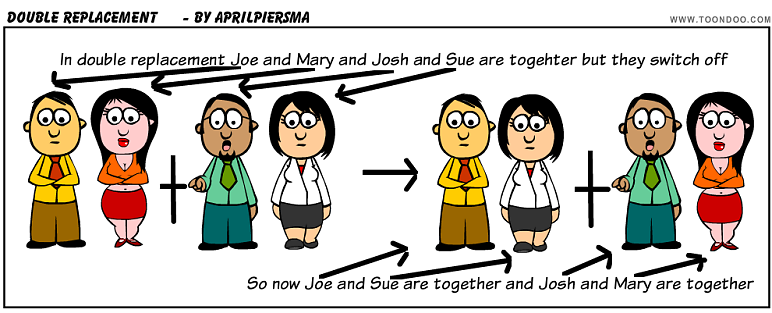
Double replacement: two compounds as reactants and the products are two other compounds. Think of it like its Halloween and you and your friend switch candy.
NaCl + KBr --> NaBr + KCl


                      1)AlCl3(aq)  +  Na2SO4(aq)  -->  Al2(SO4)3(s)  +  NaCl(aq)
When balanced:
                  _2_AlCl3(aq) + _3_Na2SO4(aq) --> Al2(SO4)3(s) + _6_NaCl(aq)
Since Cl was with Al then ended up with Na and SO4 was with Na then ended up with Al it is a double replacement.

                     2)  Zn(s)  +   S8(s)  -->   ZnS(s)
When balanced:   _8_Zn(s) + S8(s) --> _8_ZnS(s)
Since the reactants Zn and S come together to form one compound as a product it is showing synthesis.

                     3)  Al2S3(s)  -->  Al(s)  +  S8(s)
When balanced:   _8_Al2S3(s) --> _16_Al(s) + _3_S8(s)
Since the compound AlS separated to produce Al and S it showed decomposition.

                     4)  H2SO4(aq)  +  Fe(s)  -->  H2(g)  +  FeSO4(aq)
It's already balanced, atoms of each element on either side of the equation has the same number of atoms.
In the equation Fe takes the place of H creating FeSO4 because it is more active, this shows single replacement.

                    5)  C12H22O11(g)  +  O2(g)  -->  CO2(g)  +  H2O(g)
When balanced: C12H22O11(g) + _12_O2(g) --> _12_CO2(g) + _11_H2O(g)
In the equation the products are CO2 and H2O. When the reactants contain C, H and O and the products are carbon dioxide and water, combustion has occurred.
               

Predict the products

A net ionic equation includes only the components of the reaction that undergo a change.
To write a net ionic equation:
1) write a molecular equation (you do not need to balance it yet)
2) break apart into ions all strong acids, strong bases,  and soluble salts (unless they are present as a solid, liquid, or gas).
3) make sure to leave all solids, liquids, and gases together
4) Remove all spectator ions (= ions that occur unchanged in any way from the reactant side to the product side)


Sources
http://www.chem.wisc.edu/deptfiles/genchem/sstutorial/Text1/Tx14/tx14
http://chemistry.tutorvista.com/inorganic-chemistry/redox-potential.html?view=simple
http://chemistry-group4.blogspot.com/2010/03/decomposition
http://citadel.sjfc.edu/students/jas05321/e-port/Reactions%20Study%20Guide.html